Designing out loss without designing out trust
Working with Accenture technology, Coles had installed three new technologies into its self-service checkouts to reduce theft: gates that only open on payment, a camera that checks the bottom of the trolley, and an AI assisted tech that registered when items had not been scanned correctly, or at all.
Bottom of Trolley technology means that customers don’t have to remove heavy items from their trolley before scanning: a big source of loss.
The ask
Work out what the loss prevention technologies were doing to the customer and team member experience, and design the future-state self-checkout around them to minimise any negative experience.

The target state customer journey centred on a family of four, the Wongs.
What I found
The technology was working. Team members told us walk-offs had dropped sharply since it went in, and most customers understood why it was there.
What it cost to get to that outcome was the problem. A meaningful share of the interventions were false positives, so people who had done nothing wrong, or made a genuine user error were being made to stop what they were doing so that a team member could intervene and allow the transaction to continue. The on-screen message did not tell them how to fix it. When a gate failed at the busiest hour of the day, the queue backed up and the team member (often a young casual worker) was the one in the firing line of any resulting customer anger.
The brief was written to prevent store losses, but the binding constraint was trust. Every intervention that fired on an honest customer eroded it, and the people who paid were the customers standing at the checkout feeling resentful or team members just trying to do their jobs in an environment free from abuse.

The pick list before optimisation for loss prevention.

The pick list after optimisation, behaving in a way more familiar to online customers for consistency.
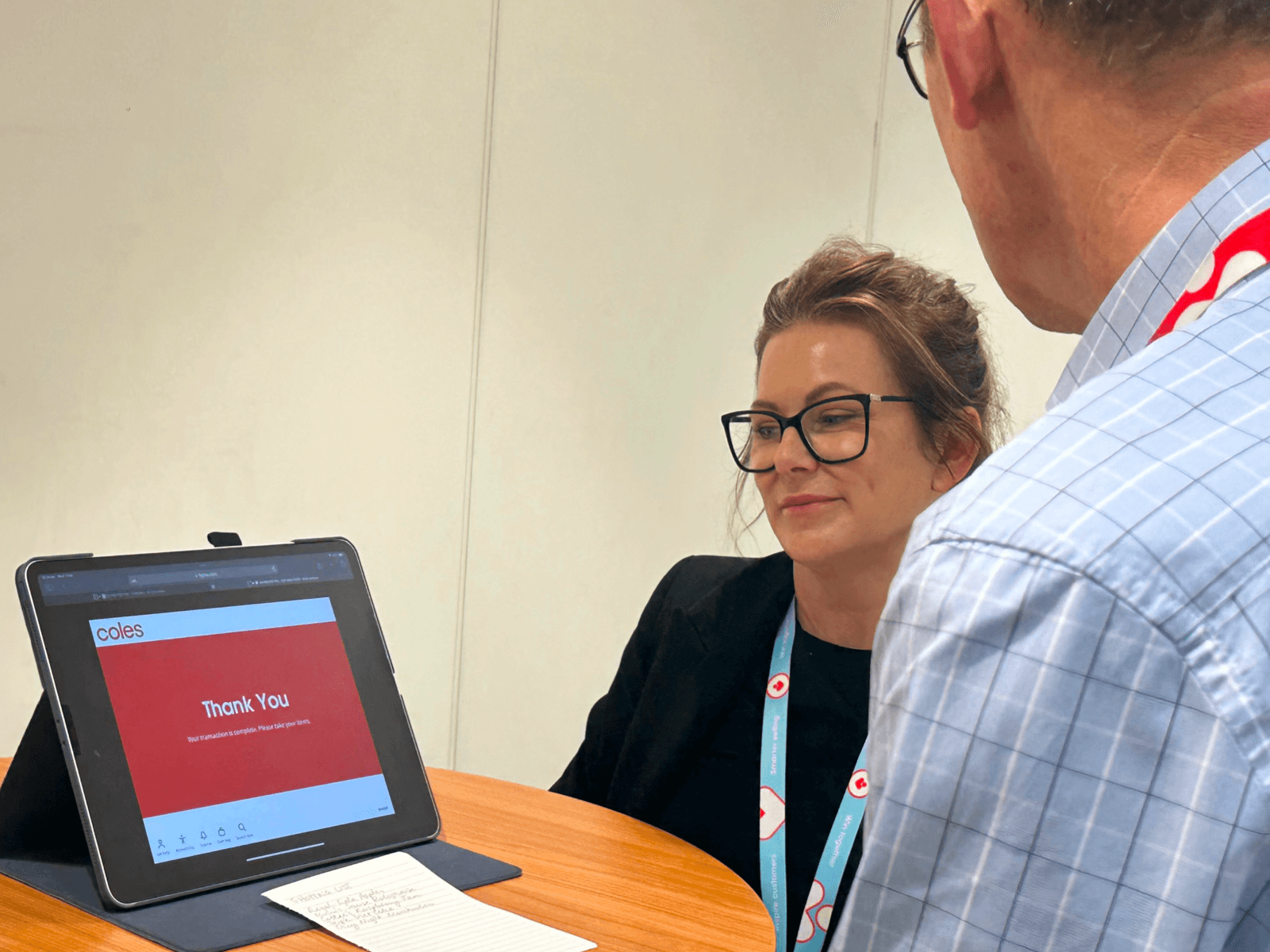
Testing the new checkout flow.

Two days of co-design workshops.
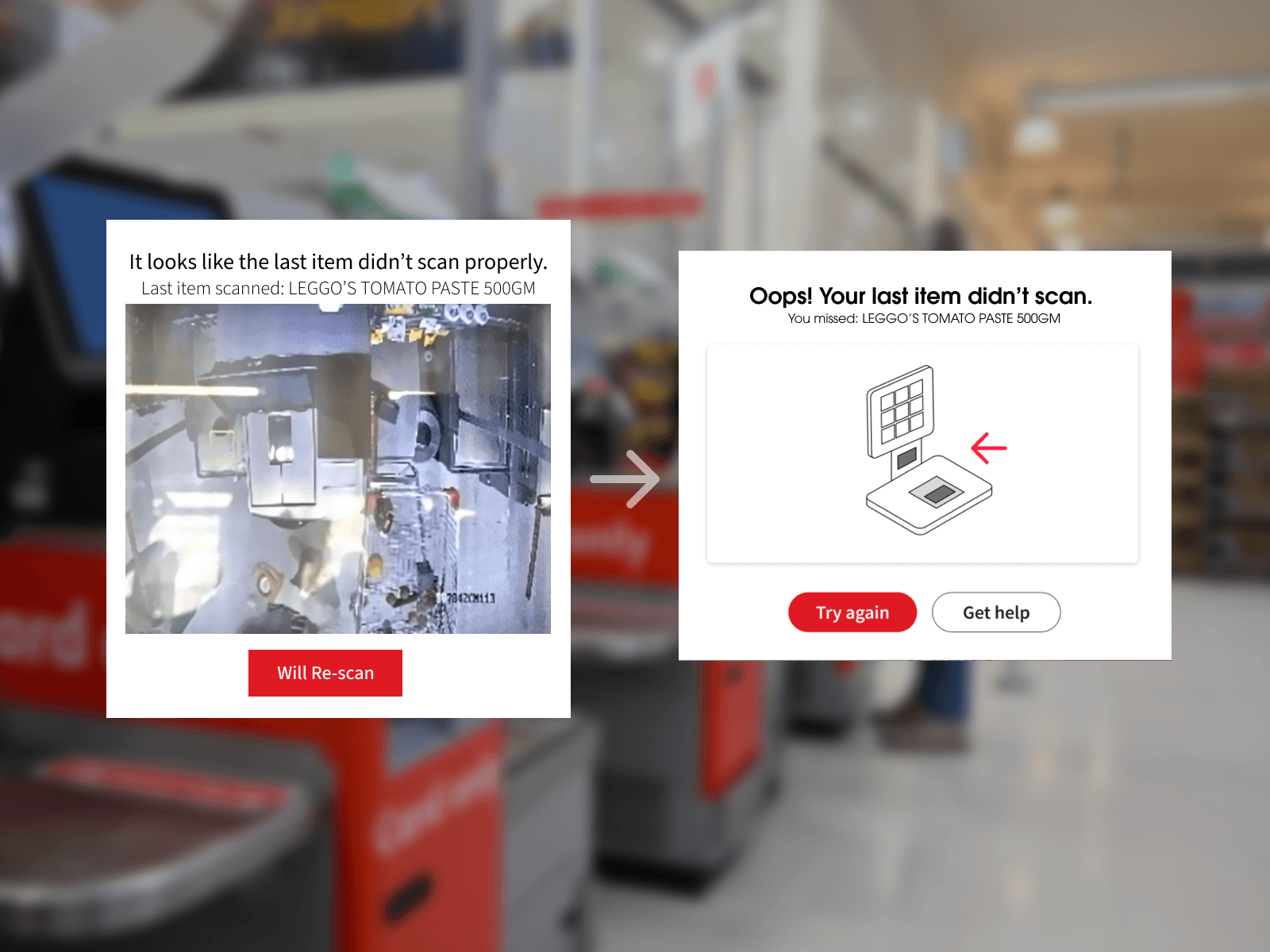
Customers feeling surveilled is a huge contributor to trust erosion. Removing these images and changing the copy to highlight potential human error would minimise resentment.
What we did
We started in the stores. Two in-store visits, eleven interviews with team members, customer service managers, loss managers and store managers, and conversations across four separate Coles teams who each owned a piece of the problem but had never had the opportunity to map it together. That produced a current-state journey for the self-service checkout, built with them rather than presented to them.
Then two full-day co-creation workshop with around twenty people from loss prevention, store operations, customer experience, customer insights, innovation and store transformation. We agreed a shared ambition first, because the tension between loss, customer experience and team member experience is the kind of thing organisations resolve implicitly (and often badly) unless you help them resolve it out loud. Six themes came out of it, a future-state journey, and more than thirty concepts mapped against impact and effort.
Four weeks after that went into re-thinking the screens themselves: the item pick list, the pre-paid flow, and the intervention screens for two of the technologies. We tested on paper with customers before anything was built, and reworked it against what we learned.

I created a playbook that would enable the internal team to approach similar challenges in future with confidence.
Where it landed
Coles finished with a current-state and a future-state journey for self-service checkout, a prioritised portfolio of concepts with two shortlisted into the next sprint, and redesigned screens tested with real customers.
The part they appreciated most is the service design playbook and methods library, delivered through working sessions across the eight weeks rather than handed over at the end. Four teams who had been solving this separately now had a shared way of working on it, and the capability to run the next round without us.
What I’d do again
Holding the line that the work had to be designed for the customer who is trying to do the right thing and getting it wrong, rather than for the small number who are not. Loss prevention pulls a business towards designing against its worst customer, and every control added for that person is paid for by everybody else. Especially the often young teenage workers just trying to keep the self checkouts moving. It was as much about workplace safety as loss prevention.
The same thing had been true at WorkSafe in a completely different sector. Most non-compliance is confusion rather than an intention to do the wrong thing for the sake of expedience.
Client
Coles
Role
Design Director
responsibilities
Service design North Star Development Journey mapping Co-design facilitation Capability building
DURATION
9 WEEKS