Transforming Victoria’s last paper-based government service
WorkSafe is the state agency that regulates workplace safety in Victoria and runs the workers’ compensation scheme. Almost every business in the state has to deal with it, and most would rather not. At the time we worked with them, they were one of the last paper-based government agencies in Victoria.
The ask
The WorkSafe 2030 agenda would transform an analogue regulator to a digital leader, across four streams at once: the customer portal, workplace inspections, insurance premiums and high-risk licensing.

Licensing was one of four streams. Proof of identity moved from a counter visit to a five-minute check that lasts ten years.
What I found
WorkSafe was established to respond after someone got hurt. Merely putting the forms online would have made a reactive system faster without making it better. The real question was whether the same program could move WorkSafe towards preventing harm in the first place.
There was a second ambition. Workplace injury in Victoria is increasingly moving from physical to psychological, and a regulator designed around preventing physical harm has to learn to see harm it cannot photograph.
Research revealed that most businesses failing to meet their WorkSafe obligations were not avoiding them. Rather, they were confused by them. Around 90% of duty holders sit somewhere between wanting to comply and being emphatically committed to it, and get it wrong anyway because the processes are unclear. Only a small minority are consciously avoiding compliance.
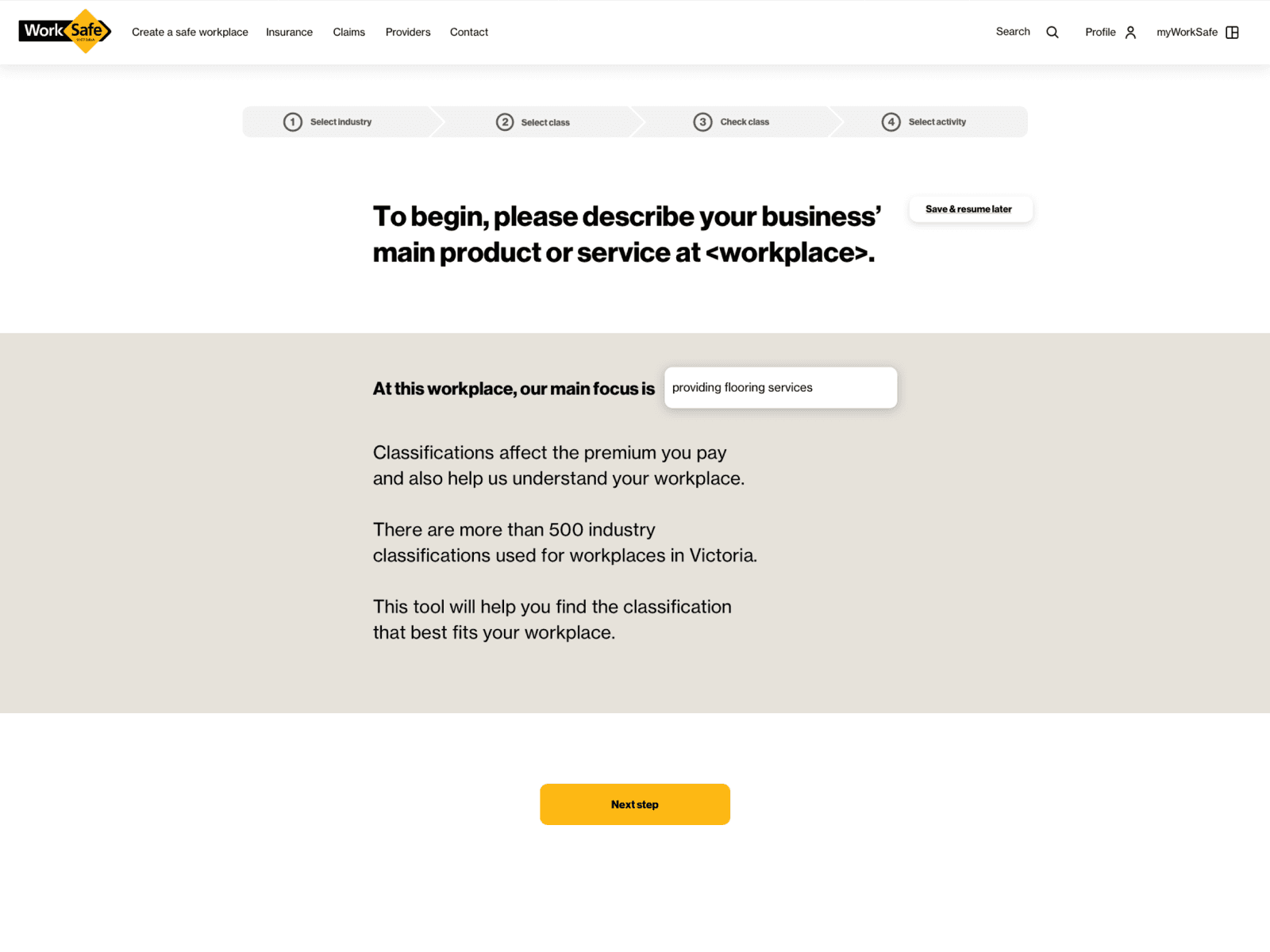
The first question. Most people can describe what they do in a sentence. Almost nobody can find that sentence in a classification list.

The last screen exists because being confident and wrong is the expensive failure here.

Narrowing by predominant activity, instead of asking a business owner to read a taxonomy.

Most of the job was holding a single coherent position across organisations that were not always pointed the same way.

Setting communication preferences for businesses accessing multiple WorkSafe services.
What we did
I came in as design director partway through a multi-year engagement, inheriting four streams, the toolchain, three research recruitment agencies and an $80K research budget. Over 24 design and build sprints, the program ran to more than 85 people across the four streams, with up to 10 designers reporting to me at any one time. A separate strategic transformation partner ran alongside us, so a large part of the job was holding one coherent design position across organisations that were not always pointed the same way, inside an institution with no habit of working this way.
The most difficult challenge of the program was the smallest part of getting compliance. Every business has to tell WorkSafe what kind of work it does. That answer sets the WorkCover Industry Classification (or WIC) it is given, and the classification sets what a business pays for workers’ compensation insurance. Get it wrong and it can cost you, sometimes for years. The list of activities you have to find yourself in to estimate the level of cover required runs to the thousands.
To help duty holders to pick the right WIC for their business, we prototyped a new digital lookup tool (affectionately dubbed ‘Pic-a-WIC’) and tested it in multiple rounds with real businesses including cafés, carpenters and restaurants. Early prototypes produced the worst possible result: 15 out of 15 people completed the task and only three got the right answer. Everybody was confident and almost everybody was wrong.
What we were watching was an availability heuristic. People chose whichever classification was easiest to find rather than the one that actually fitted. That is a predictable human shortcut, not carelessness, so the fix had to be structural rather than better instructions. We rebuilt the exclusions logic to remove recursive loops, filtered the options down by predominant activity, and in doing so changed the process from asking people to navigate a taxonomy built for actuaries, to one built for time-poor business owners.

A simple, heavily branded interface was high on utility and accessibility compliance.
Where it landed
Pic-a-WIC was a world-first self-classification tool. It beat its 75% accuracy target and got internal recognition for solving a problem WorkSafe had been dealing with since the 1990s.
The prevention work was redirected around who it was actually for, and human-centred design got a foothold in a traditional public institution that had not worked that way before.

The portal. One place to see what WorkSafe knows about you, instead of a phone call to find out.
What I’d do again
Writing the recommendation to drop personas and use attitudinal mindsets instead, scoped to the 90% of duty holders disposed towards compliance rather than the small minority consciously avoiding it, and focused on occupations carrying high physical and psychological risk. Regulators are built to watch for people breaking the rules. Almost every compliance problem in that system was a comprehension problem cosplaying as defiance, and you cannot design your way out of that by policing the minority harder.
Client
WorkSafe
Role
DESIGN DIRECTOR
responsibilities
STAKEHOLDER MANAGEMENT THIRD PARTY VENDOR LIAISON PROJECT GOVERNANCE TEAM LEADERSHIP WORKSHOP DESIGN AND FACILITATION USABILITY TESTING
DURATION
MULTI-YEAR, 24 SPRINTS